
Here is an example of the 4MAT process with regards to assessment:
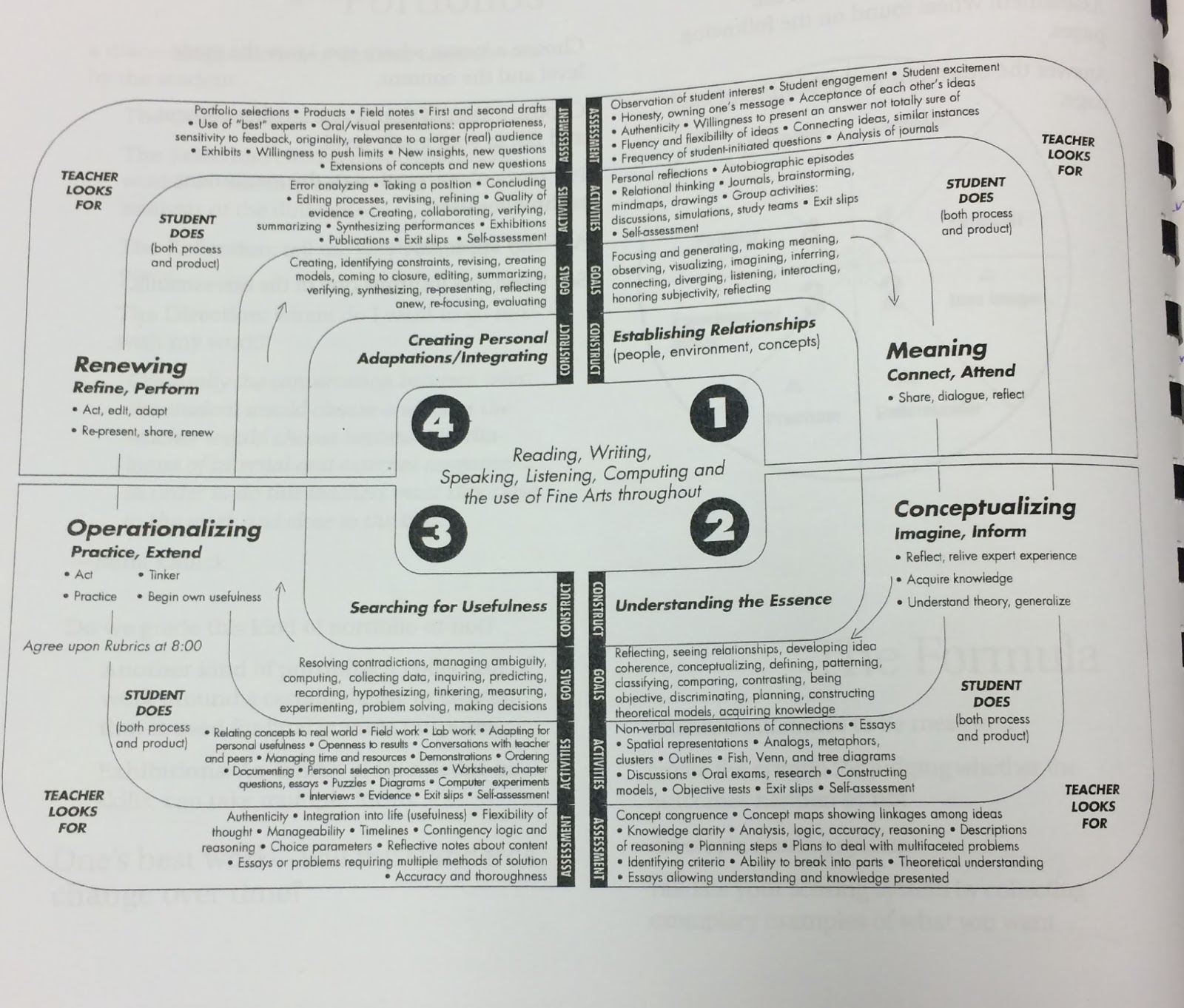
In our class we had to make two lesson plans here are the two:
Subject: Math: Algebra 2
Grade Level: 10th and 11th
Concept: Character
Topic: Properties of Real Numbers
Length of Unit: 6 Days
Essential Question: How do you characterize properties of real numbers?
1R (Connect)
Objective: Students will connect to characteristics by completing the ‘Guess Who’ game.
Activity: Play ‘Guess Who’ with partners. Then as a group play ‘Guess Who’ with the teacher. Student’s will try to find the teacher’s character. Each player starts the game with a worksheet that includes cartoon images of 24 people and their first names. Each player selects a character of their choice from the group containing the same 24 images. The object of the game is to be the first to determine which card one's opponent has selected.
1L (Attend)
Objective: Students will make meaning of characteristics by reflecting in their journal.
Activity: Students will journal how they found characteristics of the teacher’s character and/or their partner's character. Students will also journal other characteristics of different characters in the “Guess Who” game. What made selecting different characteristics better than other characteristics?
Assessment: Teacher will check for understanding by analyzing the student’s journals.
2R (Image)
Objective: Students will see a relationship between numbers and having characteristics.
Activity: Students will be put into groups and given different numbers in an envelope. Student’s will look at each number and put the number into a group. They can put them in any type of group, but will have to defend their answer when talking about where they placed their number.
Assessment: Teacher will check will for student engagement through observation of student participation.
2L (Inform)
Objective: Students will acquire knowledge of properties of real numbers through lecture.
Activity: Lecture to students the difference between rational and irrational numbers. Students will be able to classify numbers (such as: integers, whole numbers, natural numbers, irrational numbers, and rational numbers.) There will be a discussion on the differences and similarities of rational and irrational numbers.
Assessment: Teacher will check for understanding through analysis of student’s notes.
3L (Practice)
Objective: Students will show their understanding of real numbers by completing card sort.
Activity: Students will have to determine whether a number is rational or not and why, this aims to identify and assist students who have difficulties in classifying numbers and moving between different representations.
Assessment: Teacher will measure proficiency by recording the card sort performance. See attached card sort and assignment.
3R (Extend)
Objective: Students will make decisions on property of real numbers. Students will create an infographic showing their understanding.
Activity: Students will create an infographic of the properties of real numbers. This infographic will include a flow chart of finding the right property based on the yes/no questions of the flow chart.
Assessment: See attached rubric.
4L (Refine)
Objective: Students will edit and rehearse their infographic for accuracy.
Activity: The students should examine their projects and make sure it is complete. Once they are done they should rehearse their presentation for their infographic.
Assessment: Teacher will meet with students to answer any questions and to check for understanding on the infographic.
4R (Perform)
Objective: Students will present their project.
Activity: Students will present their infographics to their class, as a class we will test the flow chart with 2-3 example numbers to make sure they have the correct properties.


