Showing posts with label task. Show all posts

Creating a Polynomial Function

One thing that I have been looking forward to trying in Advanced Algebra is more tasks. One of my goals for this year is doing more mathematical talking and orchestrating better discussions in the classroom. One task I created recently that still needs work is this creating a polynomial function from zeros task. Previously students have only factored and solved polynomials with P's and Q's. I was thinking they could work their way backwards from the previous days material.


Here is a link to a better looking version.

I gave them the task to work on for 15 minutes and I went around the classroom getting students started and answering questions.  If I had more time I would have done a better job of calling students up and presenting their work, but I was running short on time. I was hoping their thinking would help them think backwards especially with day before lesson.

Some places they might have gotten stuck at that I had posed responses for:

  • Students will have a hard time getting started (it feels like a high entry task)
    • I will ask them to go through an example problem we have done before, such as x^2-4x+3
  • Multiplying the "i's" together, it has been about a full quarter since they have seen imaginary numbers multiplied together.
    • I will ask them what i squared is? What do they remember about imaginary numbers?
  • Distributing correctly.
    • Ask them how they would distribute (x+2)(x+2)?
If you are really digging this lesson, you can view 28 minutes of the lesson here. 

I still feel like the entry to the task is too high, I would love comments on how this could be a better lesson.

3 ACT Task: Beat The Freeze: Circumference


The Situation: 
During Atlanta Braves games, one fan has a chance to race "The Freeze." Who is the first to reach the end?


Act 1: First 10 Second of the Video:

The video shows the contestant running the warning track in the outfield. It shows the lead the contestant has over "The Freeze."

Have the students discuss who they think will win.

How can we prove who will win or lose? What would we have to know in order to solve this problem? Are there properties of a baseball field that we need to know before beginning?

Act 2:
At the beginning of the video it shows the distance to the left field wall. The distance to the right field wall is 325. You can use 335 or round to 330. 

The Freeze runs at 22.5 ft/sec
The contestant runs at 19.1 ft/sec

The contestant is given an 70 foot head start.

Act 3: 
Show the full video. 

Extension Questions:
How long can The Freeze wait and still win?
What if the rates changed at the midway point?
What is the biggest lead you could give the fan and win?
If you were the contestant what strategy might you use to win?


How I Teach Direct Variation

I use to teach direct variation by having students take notes, but the past few years I have been using Jon Orr's Water Bottle Flip.


There is an excellent Desmos activity that goes along with it. This year I copied and edited my first Desmos activity which was this one.

https://teacher.desmos.com/activitybuilder/custom/57f788035db373e705868c8b

I added two slides:


I wanted to emphasize direct variation and ask them deep meanings of graphs. One of the questions I asked was looking at the graph on the bottom, what inferences can you draw?

On September 8, there was the NATM (Nebraska Association of Teachers of Mathematics) Conference. During Lenny VerMass presentation, Smoke and you Croak or Huffing and Puffing to Understand Slope, he had a very interesting task. 

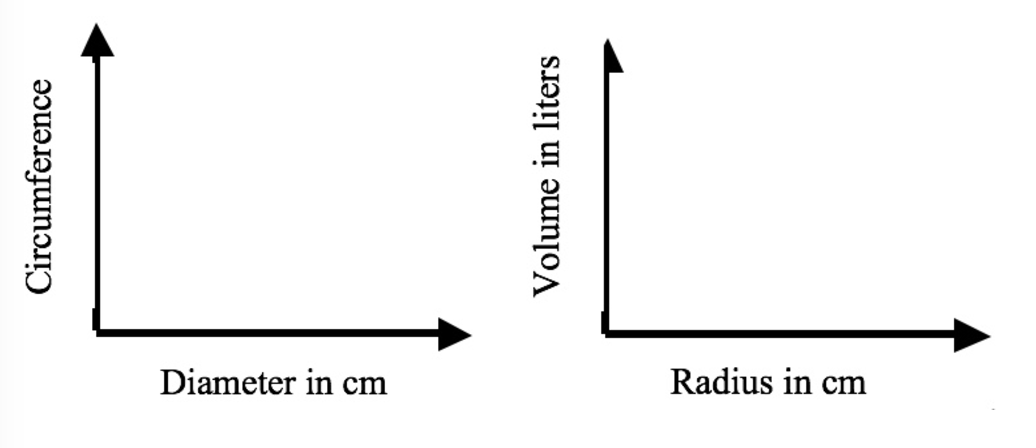
Students had to measure how much air filled their lungs. So we exhaled into a balloon and measured (3) breaths and the circumference of the balloon. Then on a big sheet of paper we had to plot all of our data points for the following graphs and interesting things happened. Try it with your students.


Gas Station Problem and Unit Rates

I was at Hy-Vee the other day filling up using our fuel save points when an interesting question popped into my head.  I was thinking if you were a gas station attendant how could you know if a person was using a fuel saver and which pump had the highest fuel saver discount based on the number of gallons and fuel price.

I made this activity to engage student thinking about Unit Rates and instead of fuel saver points they have to find which pumps are losing them money.

So I creepily took down the notes of every pump at the local Hy-Vee gas station, luckily enough I did the math on them all and had some surprising results.

The assignment is here: https://goo.gl/BYaiSn

It focuses on higher thinking about unit rates than we might typically cover.


After students complete this part of the task they have follow up questions:
  1. Which pumps need to be fixed?
  2. How much money was lost if we make $.10 on each gallon sold? Show your work.
  3. How much money did we make?
  4. How did you find your answers? (Write one paragraph)