Showing posts with label lines. Show all posts

How I Teach Direct Variation

I use to teach direct variation by having students take notes, but the past few years I have been using Jon Orr's Water Bottle Flip.


There is an excellent Desmos activity that goes along with it. This year I copied and edited my first Desmos activity which was this one.

https://teacher.desmos.com/activitybuilder/custom/57f788035db373e705868c8b

I added two slides:


I wanted to emphasize direct variation and ask them deep meanings of graphs. One of the questions I asked was looking at the graph on the bottom, what inferences can you draw?

On September 8, there was the NATM (Nebraska Association of Teachers of Mathematics) Conference. During Lenny VerMass presentation, Smoke and you Croak or Huffing and Puffing to Understand Slope, he had a very interesting task. 

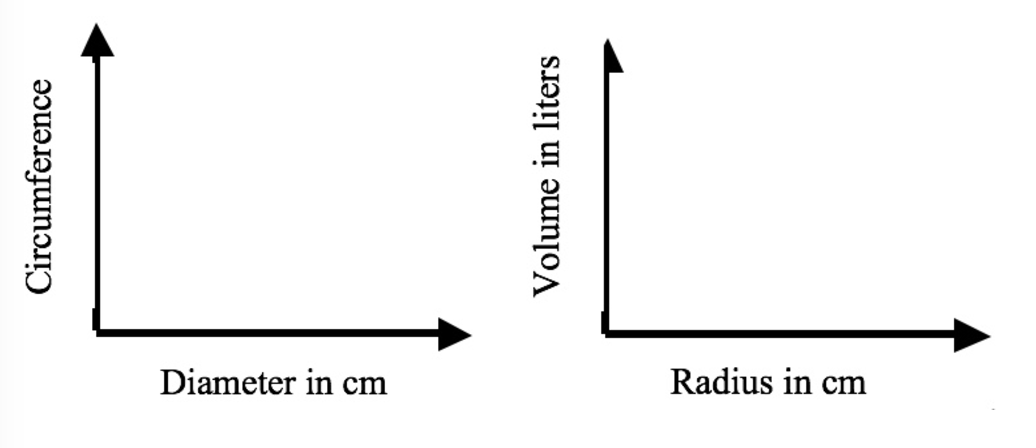
Students had to measure how much air filled their lungs. So we exhaled into a balloon and measured (3) breaths and the circumference of the balloon. Then on a big sheet of paper we had to plot all of our data points for the following graphs and interesting things happened. Try it with your students.

Artist Sol LeWitt and Points, Lines, Angles

Sol LeWitt was an artist born in Hartford, Connecticut in 1928 he was most known for his conceptual art, however in this overview we are going to focus on his Instructables. Instructables are wall art where the artist has to follow a particular set of instructions. Sol LeWitt came up with a large number of different instructions, some he never did himself.

For example Wall Drawing #65 in colored pencil is of follows:
Lines are not short, not straight, crossing and touching, drawn at random using four colors, uniformly dispersed with maximum density, covering the entire surface of the wall.

This is what Sol LeWitt came up with:


This is bad example, because it does not take in the sheer size of the piece. Since it is a wall piece it is so large that you could not fully see it from one spot.

So how does this relate to math?


Sol LeWitt has hundreds of these instructions were he takes shapes such as squares, circles, and triangles. He also loves lines, some straight some not, and vertical and perpendicular angles. So to introduce and apply the first section of geometry points, lines, and planes. We attempted our own Sol LeWitt.

Our instructions were: On a wall surface, any continuous stretch of wall, using a hard pencil, place fifty points at random. The points should be evenly distributed over the area of the wall. All of the points should be connected by straight lines.

I assigned all students a letter and then had them connect to each other, so we only really had 26 points, but our artwork was just as amazing.


It did take a little bit more time than I was planning, but the picture at the top took 8 days to make.

We talked about lines and line segments and this brought up a good conversation about how we name lines. I would ask a student which one is the longest line, but would not let them get out of their seat. So it was easier for the student to name the line segment than point.

I love using art in the classroom and Sol LeWitt's Instructables are an easy way to get art in the geometry classroom.

Below is a PDF with some Instructions to do you own.


Gene Davis Inspired Math/Art Project

One of my favorite projects we do is at the end of the first quarter. After we have gone through perpendicular, intersecting, and parallel lines I have an art project that students do. Students have to split up their piece of card stock into 4 equal shapes with a ruler on the front and on the back split the two on the front right down the middle.

I never tell students what the lines are for on the back, but they are for postcards for their upcoming parent teacher conferences. I hang up one set in the classroom and send the others home over time.

When I have them split up the front of the card stock I have them put different types of lines in each rectangle. One for perpendicular lines, intersecting, and parallel lines.

The last rectangle is for Gene Davis.

We talk about Gene Davis the artist and what he did and his accomplishments. I show them different artworks and ask them about what he did and why it is so amazing.

Some of the students think that what he does isn't art and then we look at his artwork on scale about how big each painting is and how time consuming it is for each line.

So after the artist study we finished drawing and filling in each rectangle.

Some of the different artworks are down below:


At the end this is what our Gene Davis Inspired Wall looked like. Students got to take home another one of their creations to put on the fridge and remind them that parent-teacher conferences were coming up and I was looking forward to meeting them.


Trivia Crack X: Quick Questions

Quick One Question Quizzes Using Trivia Crack X

One of my favorite games to play in my spare time is playing Trivia Crack. Now you can create your own Trivia Crack questions with Trivia Crack X with your own pictures and videos. The downfall is that you can only create one question at a time and not a whole game.


Here are the steps to create your own:

1. Find a question that you would normally put in a quiz. Take a screenshot.


2. Add the picture into Trivia Crack X.


3. Insert your answers and non-answers into a quiz.


4. Preview your final video.


You could use your video to play during a lesson, pause the video before it gives you the answer and have the students write down the answer.


Children's Books for Algebra 2

Children's books are are a great way of introducing concepts and to help build a classroom community.  Students love sitting together on the floor and listen to a teacher read aloud a picture book. Letting a picture book and prior knowledge give them a hook into the curriculum.

Here are three great books to help teach some Algebra 2 concepts.


Follow the Line
by Laura Ljungkvist

This picture book goes from the city to farms. Each scene contains questions designed to get children counting, thinking, and observing.  Children would count 5-6 times on each page.

In Algebra 2 class I am going to read aloud the book, but instead of going over the questions in the book I am going to ask different questions.

What types of lines do you see?
Which ones of these are functions?
Which of these are not functions?
What type of slope do some of these lines have?


The Man Who Walked Between the Towers
by Mordicai Gerstein

This picture book is about Philippe Petit who tightrope walked across from one World Trade Center tower to the other. He performed tricks, walking, and dancing for an hour. The book has great and different types of numbers you could number talk during the read aloud.

The way that I am going to use the book in Algebra 2 is to get students use to the idea that mathematical models illustrate the behavior of real world situations.

During the talk I am going to ask the students at specific times to model different situations in the book and ask them about the math being used.


Lifetime: Amazing Numbers in Animal Lives
by Lola M. Schaefer

This book talks about the different animals what can happen in their entire lifetime.

An example, in one lifetime an alligator will build 22 nests and lay 550 eggs.

In Algebra 2 we are going to use this book to introduce students to exponential expressions and how they can be written in different ways.  We are going to talk about If one alligator lays 550 eggs, and then one of those alligators lays 550 eggs. How many alligators in twenty generations?

Lines of Ballerina Dancers

At the Joslyn Art Museums Thursdays for Teachers we got the chance to sketch 4 ballerinas from the Nebraska Ballet Company. Our workshop first focused on the lines of a ballerina dancer in different poses. It got me thinking about the different lines of a ballerina and in Algebra 2 we are currently going over linear equations. What linear equations do a ballerina make? So I put the pictures in Desmos and this is what I found.

Here are three lines I found.


After I graphed these I thought what a great activity this would be for students. Students could do their own poses and graph them, they could be shooting a basketball, yoga poses, or football poses. 

Then I thought what if we did this every unit and students could reflect on line families and how they relate.  It is one of my big goals I want to student to learn this year: Function families share similar graphs, behaviors, and properties.

Then I tried the same graph with parabolas, which is our next unit. Almost seemed to work better.


Video Game Success: Making Video Games with Math

Start with Pixel Press Floors

Pixel Press Floors allows you to create your own video game.  In our algebra and algebra 2 units we talk about lines and graphing lines for a solid part of our curriculum.  I wanted students to collaborate and have an ending project that brought a final bang to our unit.

This app allows you to draw on screen (in paper mode) and draw out the different levels of the game. There are a ton of lesson plans and tried and true ideas here: http://www.projectpixelpress.com/education

The Rules for the Project

  • Student's need to create at least one level where they have an undefined, positive, negative, and zero slope.  They also need to have at least one other slope that is different from the rest (e.g. y=-3x instead of y=-x.)
  • Student's level needs to be playable, you need to be able to get from beginning to end as a player of the game.
  • The student's need to take a screen shot of their different levels to show their different slopes and use Desmos to graph each of the different slopes.
Here is an example level:


Students final examples should look something like this:


I want students to have a different final project.  Students will peer assess with others in the room.  Student's will need three other people to play their level and look over their paper they will have to write.  They will have a rubric to fill out about the playability of the game and the features of the game.