Showing posts with label trigonometry. Show all posts

Trig Lasers

One of the things I don't get to do often, but love to do is observe other teachers. I get to see how they run the classroom, how their routines are set-up, and sometimes see really cool lessons. In Basic Geometry Mr. Fick and Ms. Groth had a lesson they were talking about that seemed really cool to observe. They had a bunch of different targets printed, lasers, and protractors.

To review the trigonometry they have been practicing in class. Ms. Groth had one student come up and set a target on the front wall of the classroom. She had already set a piece of tape on the ground, she wanted to know the angle that would make it so a laser would shine and hit the target. She asked the class what angle they thought it would be and students guessed. She then asked what other information is needed to know so they could accurately calculate the angle. A couple of students said the height and the distance. Those two students came up and measured both of those. Students were given a handout to write down and then calculate the given angle.

Ms. Groth then did another example where she already gave them the angle and height and they had to calculate the distance away.

I think a great extension to what I saw would to give each pair of students a target, laser, and compass. Then have students calculate their own. Or possibly have some sort of putt-putt kind of station moving from one target to the next.


Ruth and the Taco Cart

I love Dan Meyer's Taco Cart if you have never heard of it, here is the task it is great it is wonderful.

http://threeacts.mrmeyer.com/tacocart/

We were recently doing this activity in Algebra 2, because I love how it uses the Pythagorean Theorem and one of my students asks, "what if you split the angle in half and walked that, because that is what I would do." I thought that would be a wonderful geometry question.

Ruth and the Taco Cart

I posed this question to my geometry students, we weren't really learning about angle bisectors, but we had already learned it as well as trigonometry. It took them about 15 minutes to use pythagorean theorem and find the time it would take. However, Ruth was much more difficult.

After students completed the time section I asked what they needed to find the angle and the distance Ruth would have to go.

There were lots of good questions. I gave the rest of it as homework and only a few were able to do it completely.


For students that did the work, I had them work in a group and work on a couple of extension problems:

  • If Ruth didn't want to talk alone, how long would she have to wait for the other to catch up?
  • What if she took a different angle?
  • Does changing the angle effect the time it takes for her to get to her destination?
The other students continued to work on the problem and were given some of these extension problems as they got the answer.

I loved the use of geometry, I will definitely use this when we are learning trigonometry.


Solving Trig Ratios and Google Expeditions

Last year I did a solving trig ratios using Google Cardboards and the app Google Cardboard, but on Android devices the app is different from one platform to the next, so I needed an upgrade. I have been looking at Google Expeditions for a while now and finally had enough Google Cardboards and extra VR headsets (thanks Alice Keeler!!).

Google Expeditions was a great app and it allowed me to introduce other concepts like history combined with math. Another added benefit was that most of my students are from Mexico, Honduras, and Guatemala and some of these ruins were close to where they use to live.


My favorite thing is that I can direct students to look at something while reading and comes with questions to ask the students. I didn't use all of the questions, but I did use the intermediate question when it came to the number of steps. I could direct students to use their made sextants to find the angle of elevation to answer the questions.


Here are some of the students on their expedition.


Here is a link to the worksheet that students had to fill out and guide them: goo.gl/uRcvkR


GIF's that Teach Math

There are many GIF's out there that are of funny cats and of many different movies.  I know that I love the occasional GIF's and especially when they are about math.  Here are some great GIF's that you can include in your classroom to spice up lessons and activities for students.


Find more here: http://www.tumblr.com/tagged/math%20gif

Circle radians gif


sin cosine gif

Find other great GIF's here: 7 GIF's for Trigonometry


Angle of Impact

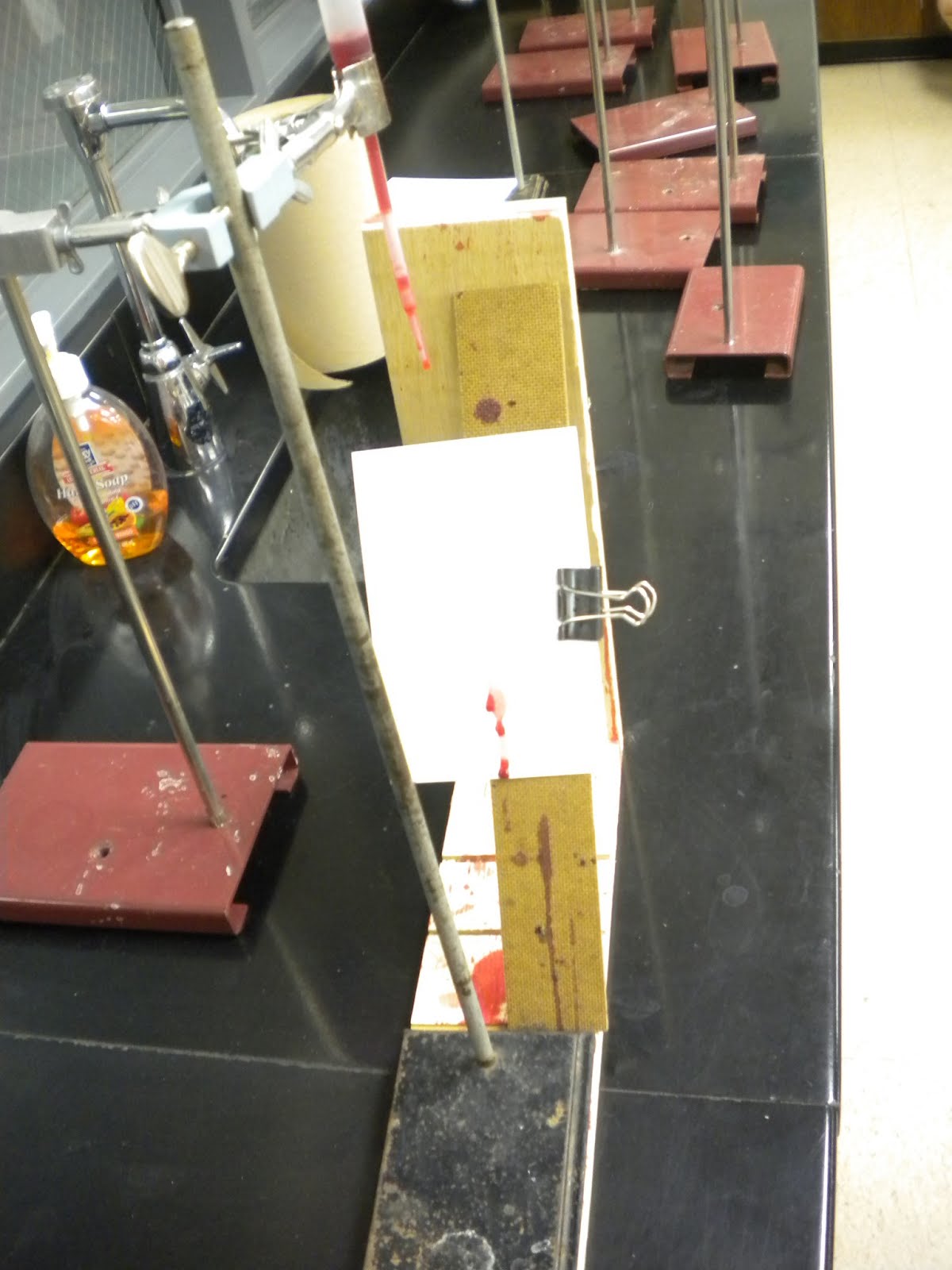
Blood splatter analysis is a powerful forensic tool.  Spatter patterns allow investigators to reconstruct what happened at a crime scene.  The blood spatter pattern "tells a story" of the crime and help the investigators determine if eyewitness accounts are consistent with the evidence.  To study impact angle, you will need to use trigonometry math skills.

Use trigonometric functions to determine if the impact angle for any given blood droplet.

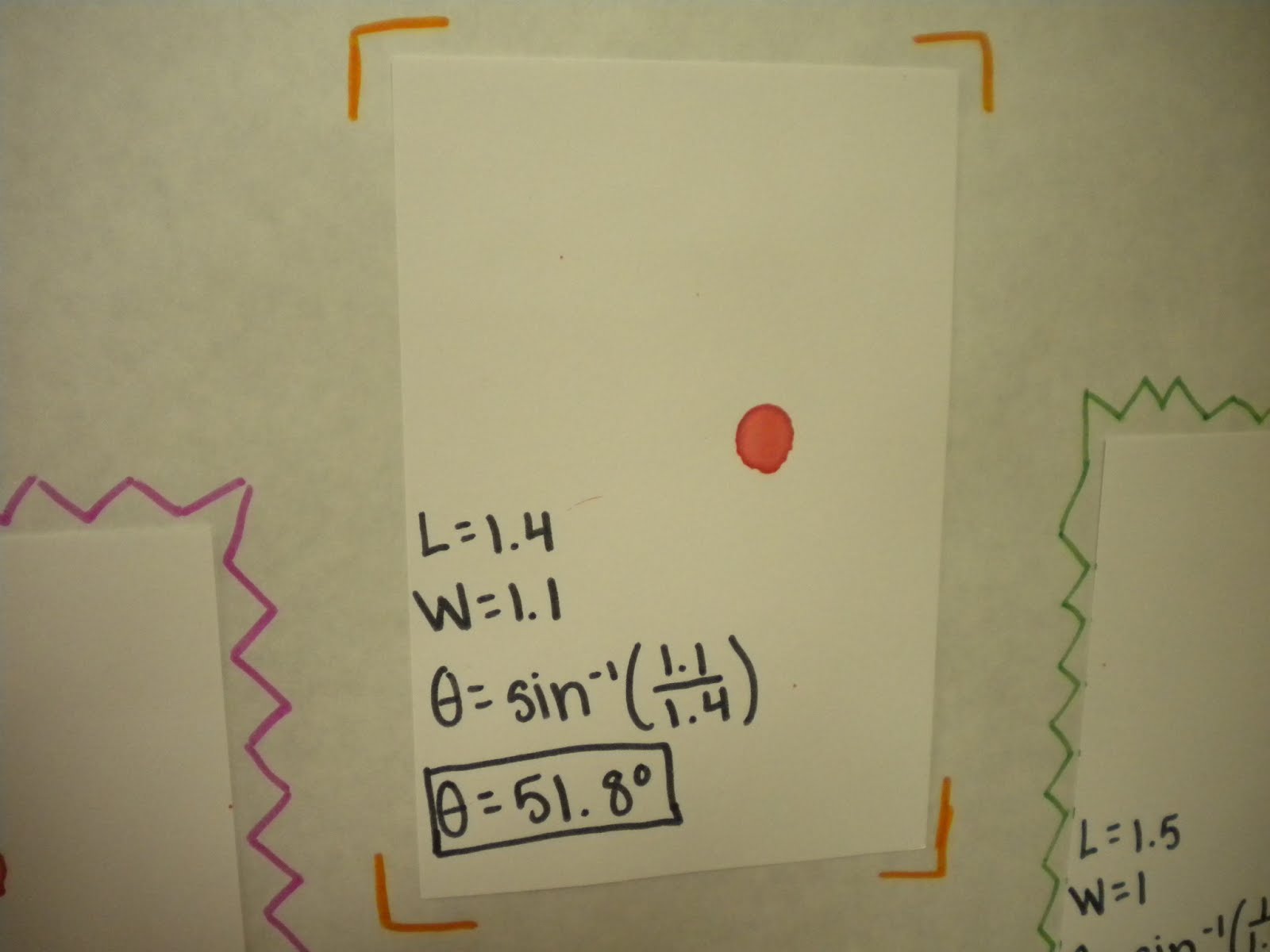
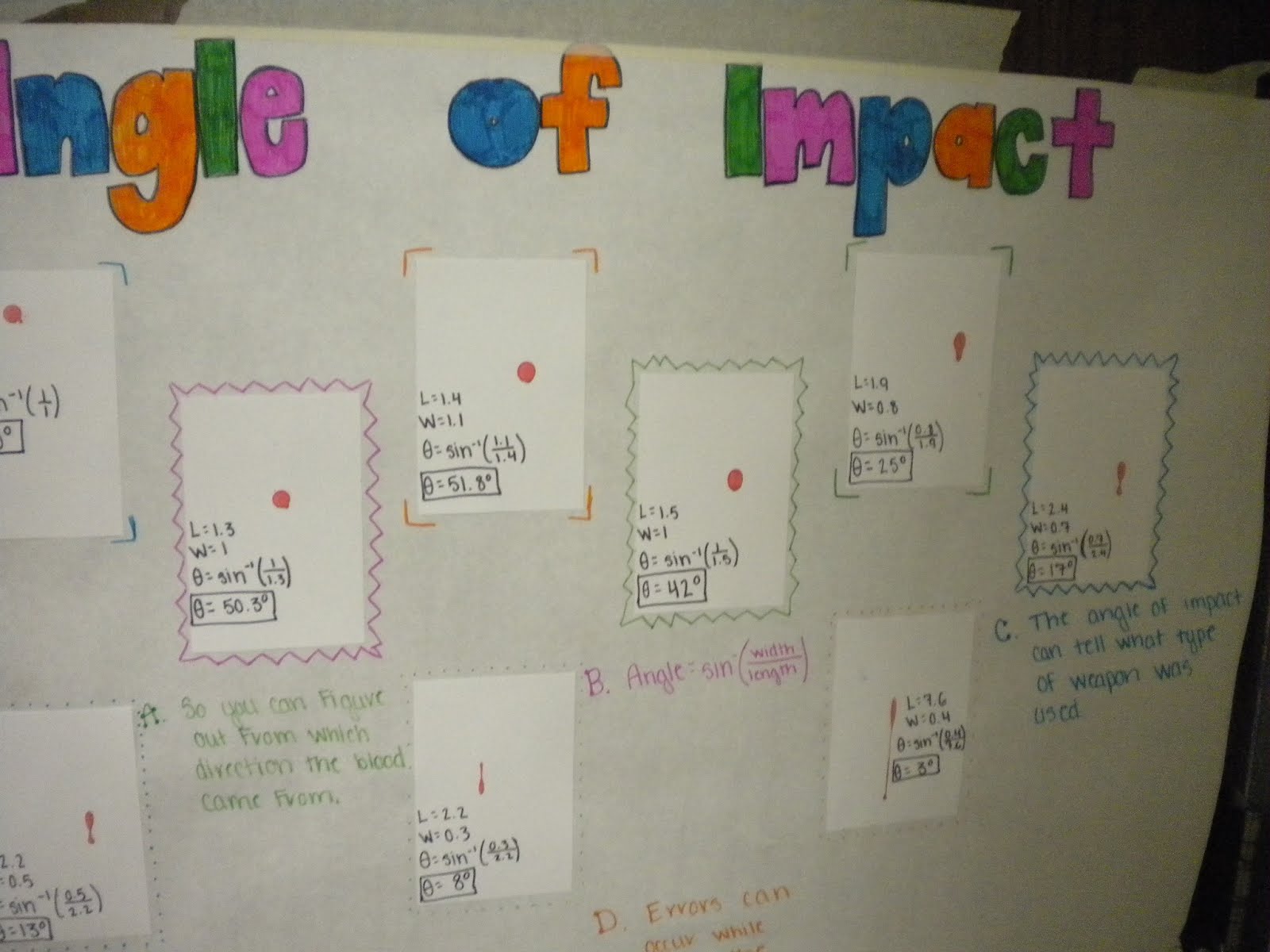
By accurately measuring the length and width of a bloodstain, you can calculate the impact angle using the following sine formula:

c=opposite/hypotenuse=width(a-b)/length(b-c).

To determine the angle of impact, take the inverse sine to get degrees.

Lesson: Angle of Impact Lab
Objective: For students to learn and use trig functions in the real world.  Students should be able to solve for angles in a right triangle.

Standards: Apply content to real-world scenarios.

Time: 45 minute class.

Set-up: 10 minutes before class.

Procedure:
  • As students enter the classroom, students will begin work on the daily question.
  • After two students go up to the board to work out the daily question, go over the correct answer with them.
  • Spend 5 minutes going over any missed or confusing questions the students had on the assignment.
  • Before the start of the angle of impact lab share with them a quick way of determining the blood splatter pattern. It should look like the image to the right.
  • Have students spend 20-30 minutes working on the angle of impact lab.  Worksheet is attached.  Students should be in groups of 2 or 3.
  • When students are finished with the angle of impact lab, students are to complete the final part of the lab with a poster.  Students should spend the remainder of the classroom working on the poster and putting their finishing touches on the assignment.
  • 2-3 minutes before the bell rings students should fill out their exit slip, for an informal assessment.

Goals: Students should be able to use their knowledge to real-world scenarios.  Students should be able to use the angle of impact formula and know how it is derived.  Students should be creative and put their math knowledge to the test to apply the concepts provided.